
Why is Clauneck much loved by Lucifer?
An Analysis of His Seal
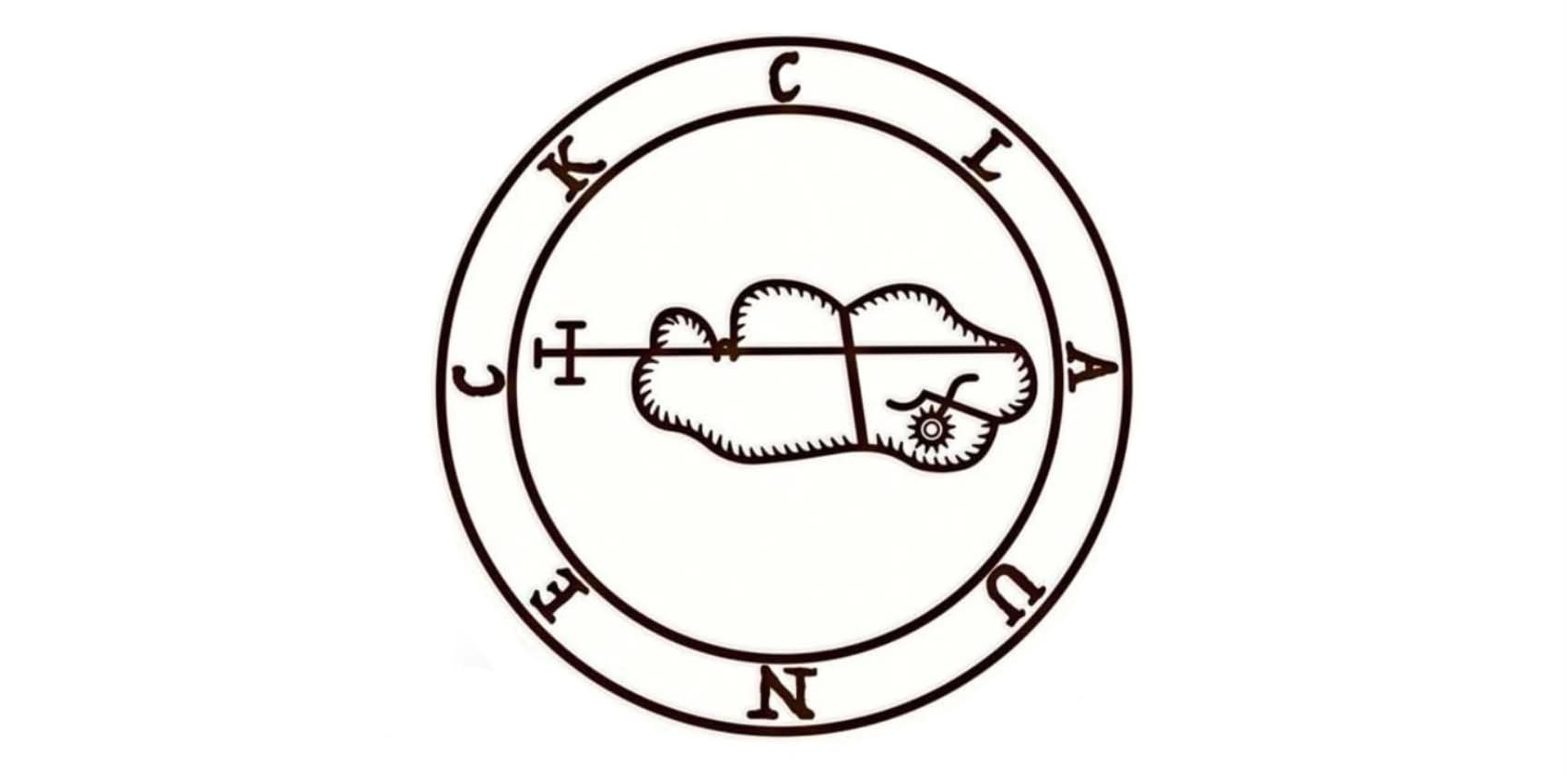
Above you’ll see perhaps the most common modern presentation of the Seal of Clauneck, first Spirit listed within the catalogue of the Grimorium Verum. We will call this variant of the Seal the “Cloud” given its irregular shape and “texture”. According to Peterson this is described as the Seal of Clauneck in Blocquel et al, for whom the original Seal was missing. This was then copied and popularised by Waite into the modern day, notably through Stratton-Kent’s recension, The True Grimoire. However, in Peterson’s 2nd edition of the Grimorium Verum you will find this Seal described as the third Seal of Lucifer (fig 1). Let’s break this down and attempt as best we can to understand what has happened throughout the history of these manuscripts and how the Seals of Spirits transform over time. We will do this by considering micro-symbols, the constituent elements of a Seal, their patterns and evolutions, found within throughout the Verum family of grimoires.
The common version above is mirrored horizontally for some reason, with the external Cross micro-symbol pointing to the left, not the right as found in the source material presented by Peterson’s 2nd Edition (see below).
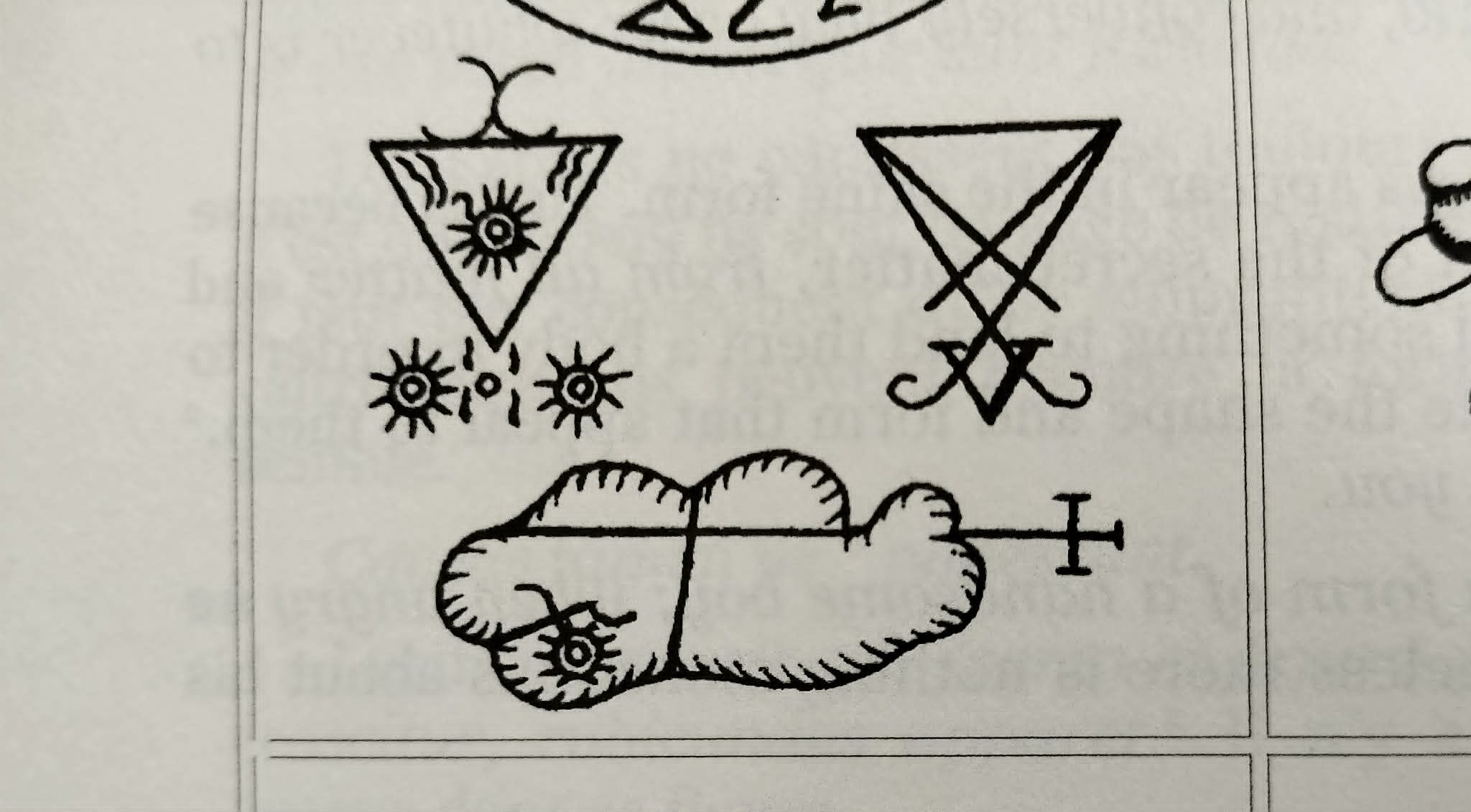
Fig 1
There is a lot of visual language we can unpack from this Seal. Clauneck is described very specifically as being, “much loved by Lucifer”, and is in fact the only Spirit in the catalogue which is given this association with any of the Verum’s hierarchy. I think this might be for a very specific reason, so let me attempt to explain.
If you look at the Seals of Lucifer presented in L’art-Magique (fig 2) you’ll see that the X and O micro-symbols inside the Cloud’s lower left quadrant are in fact derived from the same “Eye” micro-symbol. We can see something of the symbolic “bleed through” effect occurring in fig 1, where the Seal of Lucifer in Europe and the 3rd Seal have the same stylised rayed stars. While the 3rd Seal found in L’art Magique isn’t specifically a Cloud, it thematically identical given its shape and symbols.
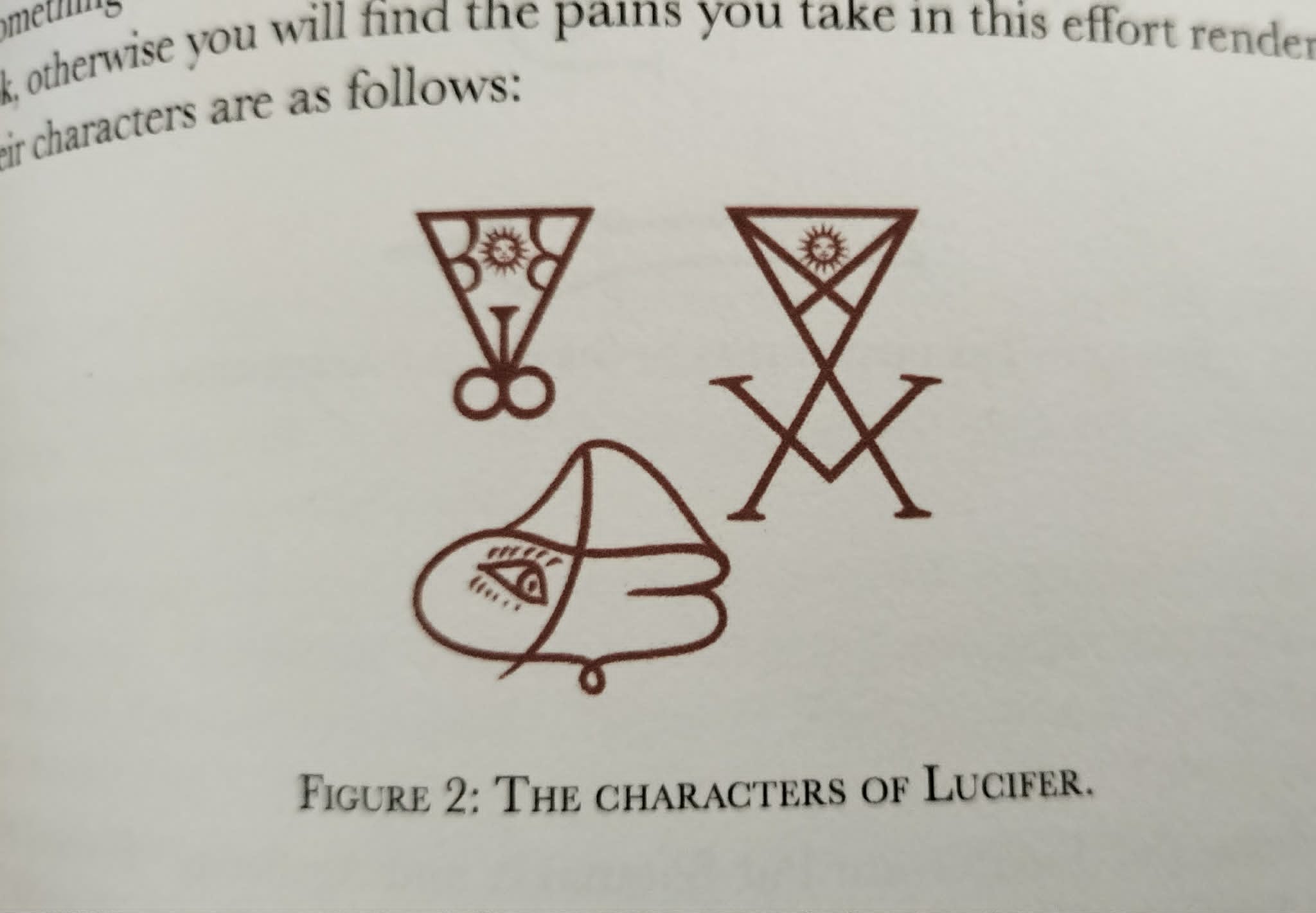
Fig 2
In both cases these Clouds are internally divided into four by a Cross, with the Eye inhabiting the lower left quadrant. I think all three Seals of Lucifer, the first two of which are described explicitly within the text (one for Europe and one for Asia), plus the additional third Seal appended (without textual explanation), are all thematically linked together with the various Seals of Clauneck, indeed, I believe they are all permutations of the very same Seal, while the Ur symbol is now lost. I think that the 3rd Seal of Lucifer was an adaptation used to fill in for Clauneck’s lost Seal, but that this inevitably became confused during transmission. A lost Seal was adapted for, but then became confused, copied and evolved independently only to now be replaced by a Seal which was itself originally an adaptation. We have to cast a wide net to attempt to prove this though. Let me attempt it.
Now, If you look at the structure of the Seal presented as “correct” in both L’art-Magique (henceforth LM) and Peterson’s 2nd Edition of the Verum, which from now on we will call the “Envelope” Seal, and compare it to the “Cloud” Seal (fig 3), you’ll see three obvious echoes in the visual language between the two.
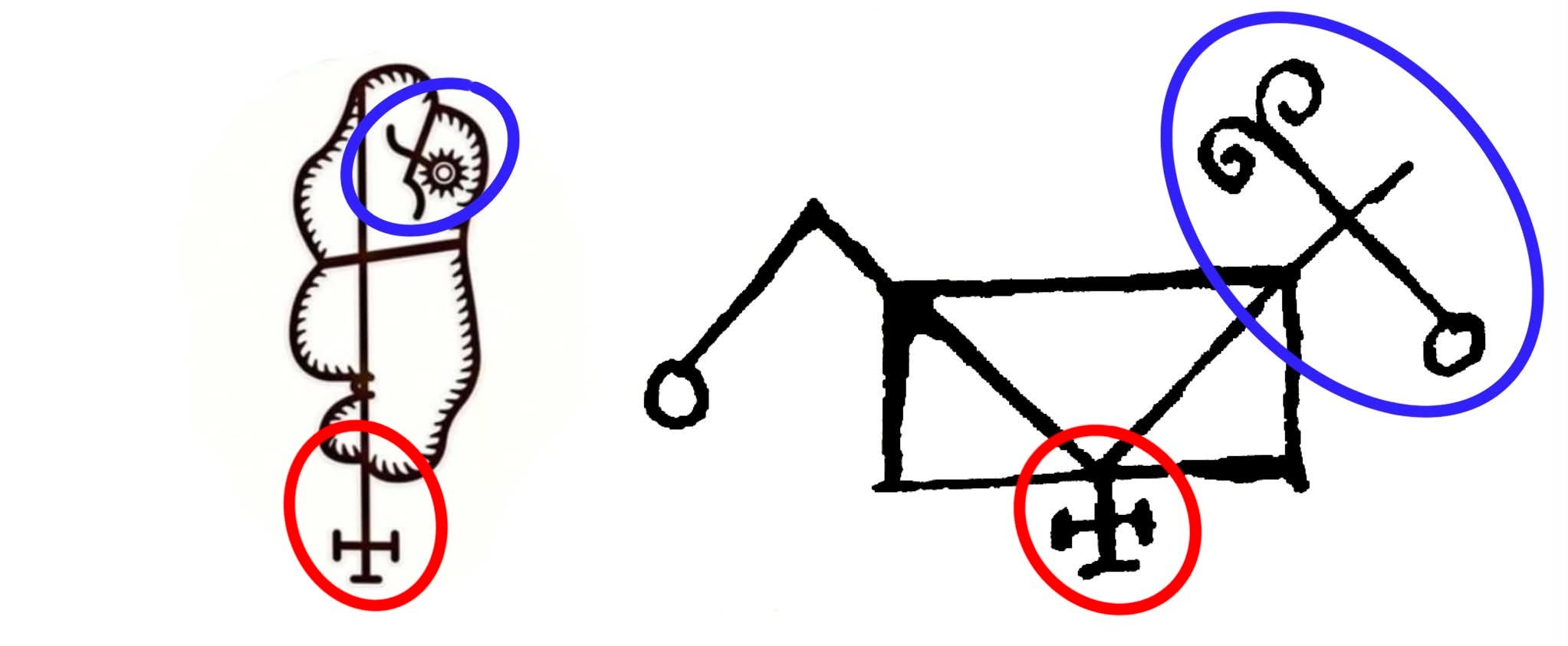
Fig 3
In red I have highlighted the first identifier, the External Cross. The second is highlighted in blue as the “Eye” micro-symbol. The Cloud found in Blocquel and Waite’s editions is missing part of a curved “Horn” as seen on the far right of the Envelope, although both inhabit the same region of the Seal, the extended section of this micro-symbol now bends in another direction and importantly, is Internal. The third echo is a closed shape divided in one of two ways. The first is irregular and Cloud-like, the second is rectangular and Envelope-like. These are ultimately the same structure, with the Cloud having two lines intersecting in another Cross, while the Envelope has two lines diverging into a “V” micro-symbol highly reminiscent of the V shapes found in the Seals of Lucifer in Europe and Asia (fig 2), both of which also have either internal Circles or Crosses.
Returning to the Envelope Seal presented immediately above, we find it possesses another “arm” which angles out of the central rectangle shape and terminates in another O. We will call these two external sections the Left and Right “Wings”. Turning to Peterson’s Secrets of Solomon and Skinner and Rankine’s translation of, The Universal Treatise (fig 4). You’ll see that both versions of these Seals are Envelopes flanked by Wings, however the internal V shape is replaced by an Λ with a vertical line.
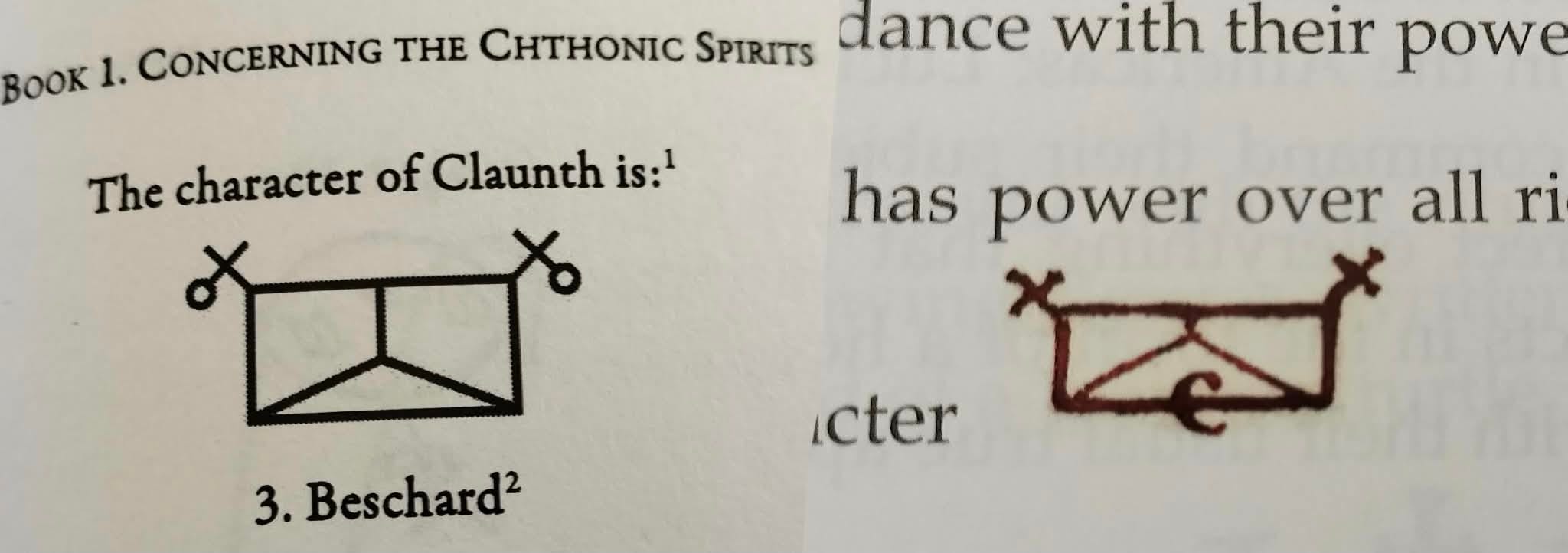
Fig 4
The version presented in Secrets of Solomon (SoS) is shown above on the right. It has two Wings terminating in O’s, whereas the version presented in The Universal Treatise (UT) terminates in Crosses. Both SoS and UT only present two Seals of Lucifer (fig 5 + 6 respectively), and so presumably their version of Clauneck’s Seal has yet to evolve into the Cloud-Eye Seal we see appended later in the LM and Verum.
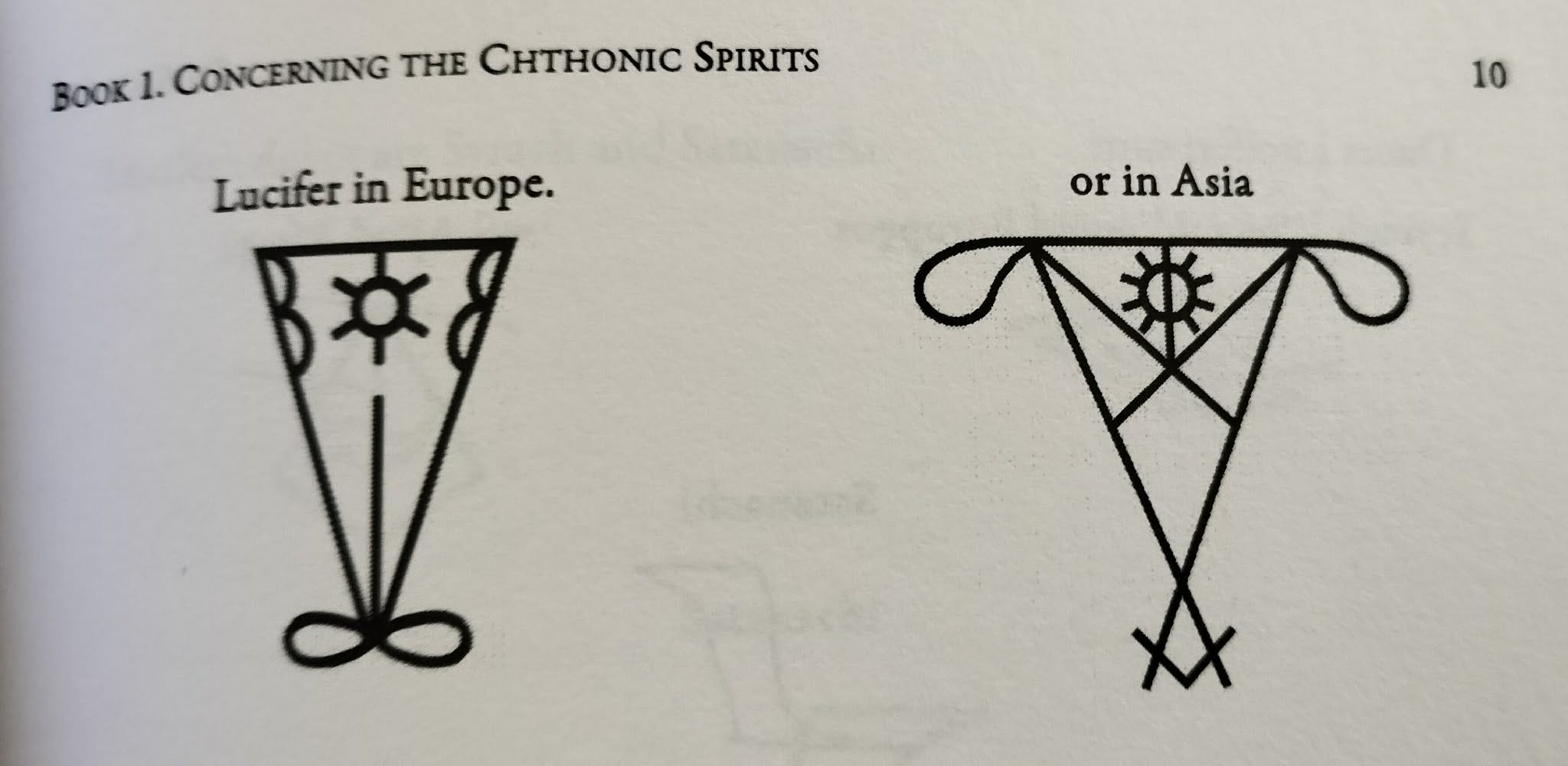
Fig 5 - SoS
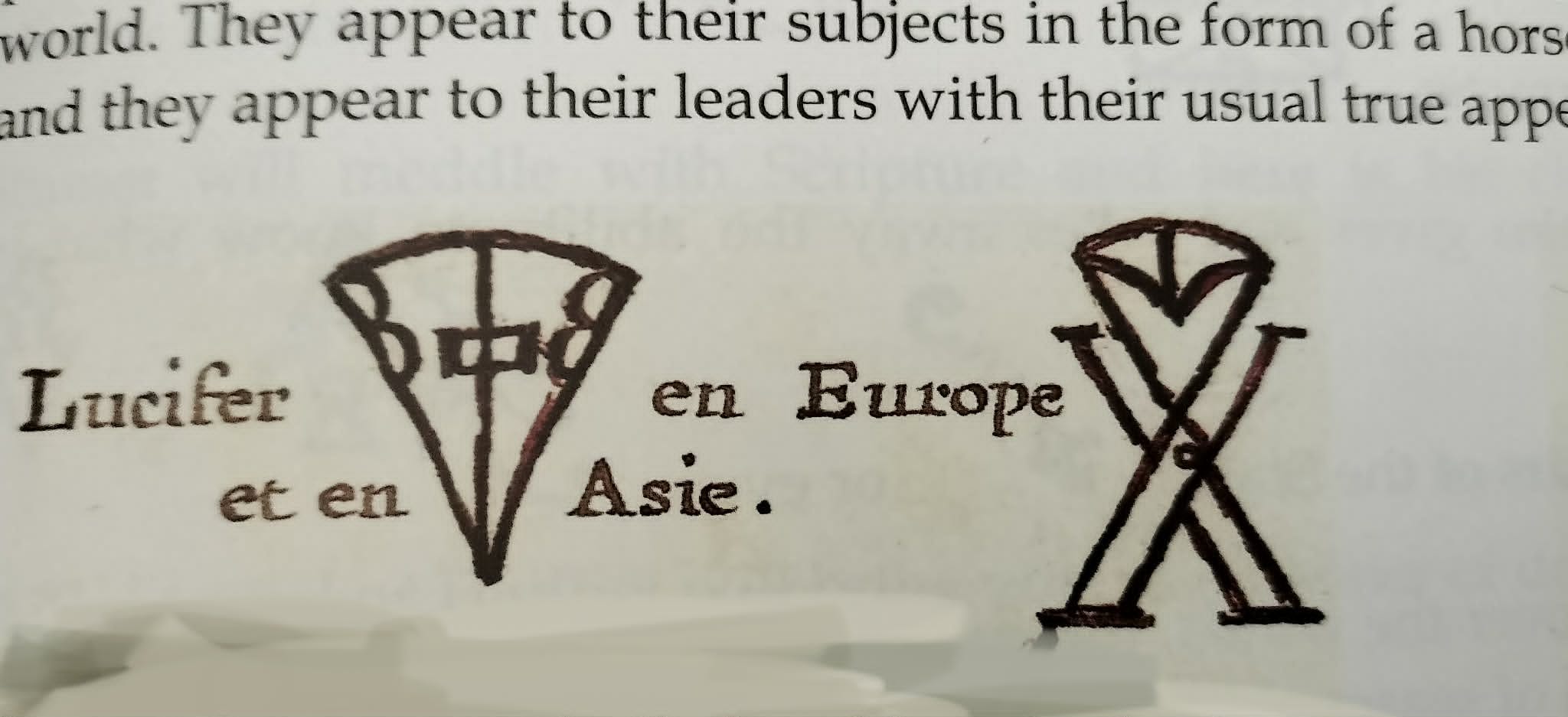
Fig 6 - UT
There are two final thematically similar micro-symbols found between Lucifer and Clauneck. The first is that, as mentioned above, the internal V of the Envelope Seal is thematically similar to the V or Λ of the Seals of Lucifer, with the Λ variant, specifically attributed to Lucifer in Asia, being present throughout the Verum family. This variant, found in SoS and UT, contains a micro-symbol extremely similar to the internal structure of Clauneck’s Envelope Seal described in the experiments section of SoS (fig 7) found in ASV (Venice), the only manuscript to contain the complete text, specifically the internal downward facing Λ with a vertical line through it. This mirrors the V with a vertical line through it found in the Seals of Lucifer in the East in SoS and UT.
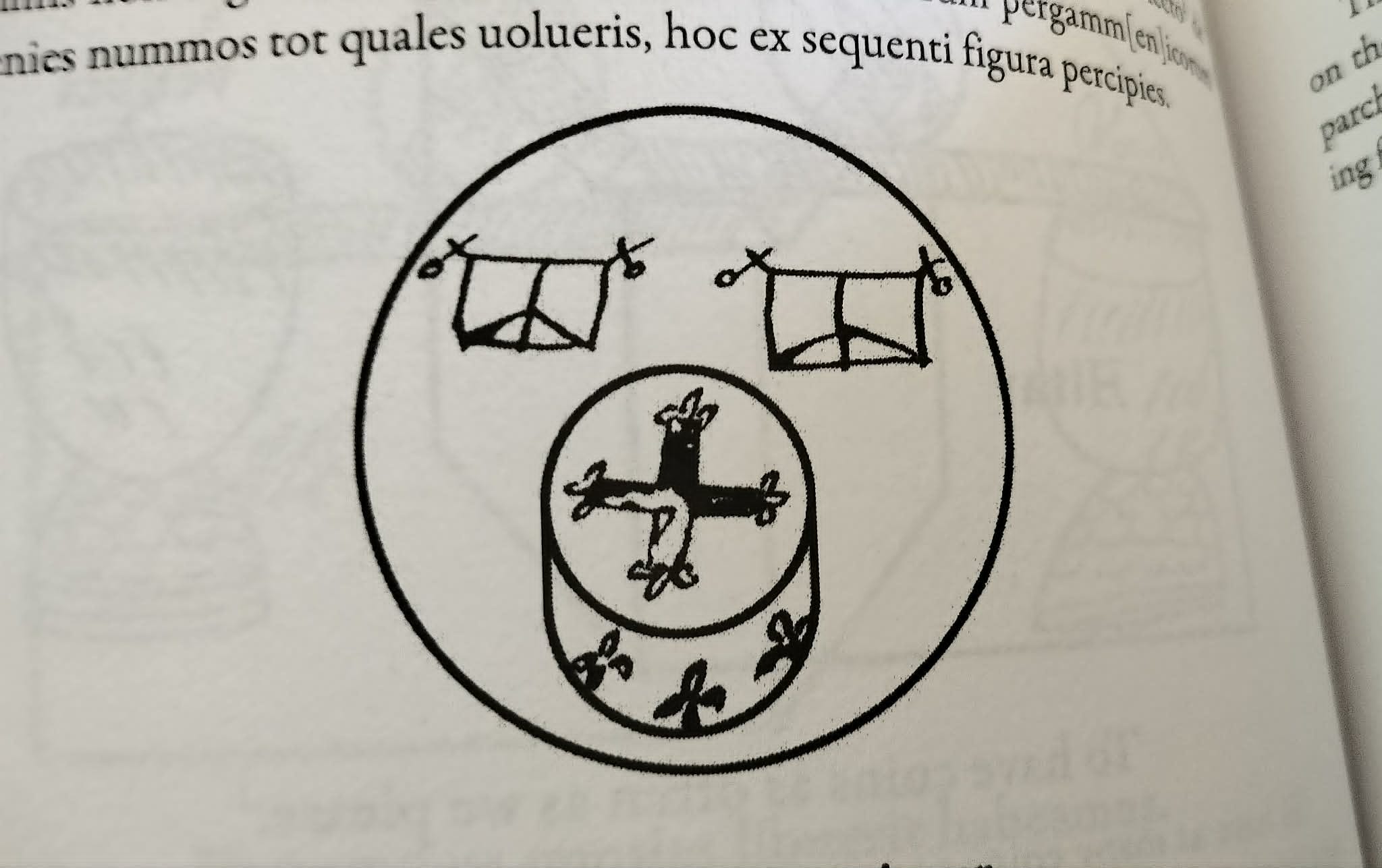
Fig 7 - Secrets of Solomon page 41
As an aside, I should note that the First Character has instructions that it should be inverted to be activated in LM which you can find on page 15, footnote 94. The figure presented has its external Cross pointing downwards here, and in Peterson’s Verum we find the very same symbol with the Cross upright and “active”. Perhaps something of this process of deactivation - activation via inversion was echoed in the evolution of this particular Seal?
Finally, in fig 2 we find that all three Seals of Lucifer found in LM contain an Eye, literally in the case of the 3rd Seal, but found as a miniature “Sun” symbols in the two corresponding to Europe and Asia. We can see this same Sun in the Seals of Lucifer from SoS, while in UT they may have transformed into a small rectangle for Lucifer in Europe and a very tiny square at the summit of the Λ micro-symbol for Lucifer in Asia. It is easy enough to see how these Sun micro-symbols evolved into an Eye, which was then transmitted to the Seal of Clauneck as found in Waite, but we also see how it could have transformed over time into the external open Horns appended with an O found in the Envelope version in LM.
I argue then, that the Ur Seal of Clauneck is lost. It’s also safe to say then that the Envelope pattern is far more consistent, despite not being the Ur symbol, although we can’t say for sure which permutation, V or Λ with Wings is “correct”. What we have is an adaptation of the Seal of Lucifer which has gone through a great many transformations. The “C” micro-symbol added to the bottom of the Λ Envelope found in UT (fig 4) is almost certainly a marker delineating it as a Seal belonging to Clauneck (here named Chauntha), perhaps to distinguish it further as its own Seal distinct from Lucifers.
The manner in which these Seals evolve over time is truly fascinating and there isn’t a complete picture of an “Ur” symbol for any of the Seals found in the Verum or the constellation of its extant cousins. In many cases we see a high level of adaptation and evolution of the Seals, at most we get thematic echoes as opposed to any hard conclusions. There are perhaps four factors in particular which drive this process. The first is that the Seals were copied incorrectly by a sloppy scribe. The second is that they were earnestly copied from memory by a scribe that tried their best but didn’t quite get it exact. The third is that the Seals were elaborated upon or adapted due to missing information, something very common to this particular stream of the Grimoire current. This was almost always done by supplementing one Seal for another and we see evidence for this all over the Verum. Finally it may be that a scribe altered the Seal after legitimate contact with a Spirit. This happens a lot in my own personal work. I begin with a Seal that I intellectually rationalise to be the best or most suitable, then during contact with the Spirit I ask them to guide my hand as I create their Seal for them anew and write it within my Red Book. The result is often subtly different, but maintains some thematic micro-symbology from one or more extant variations I have access to.
What do we conclude from all this? Well, the first is, stop worrying about creating your Seals to the Spirits “correctly” because in most cases the Seals we have access to have been chopped up, mixed around, innovated upon and mistaken. The Seal is not a ontologically equivalence to the Spirit in question, it’s just a calling card, and ultimately people get new phone numbers, move house or die. If we approach the grimoires as monoliths then we get a skewed image of the Spirits, as if they’ve been locked in amber all these centuries and not a part of an ongoing, ever evolving and dynamic ecology. Try your best with what you have and see what the Spirit has to tell you. That’s how we make progress.
If you’re interested in similar breakdowns, such as for the Seals of Klepoth and Frimost and their intimate relationship together and with the Wands of Hazel and Elder as used in the system of the Grimorium Verum then please come check out The Vault and our Discord community.
Follow the link below for an introduction to our Guide:
Joseph H Peterson has shared some fantastic info on how the 3rd Seal of Lucifer came about within the textual transmission. I absolutely have to edit my work to include this new information because it's really cool.