
ZAZEN
坐禅 - A Wonderfully Useless Art - An Unnumbered Task
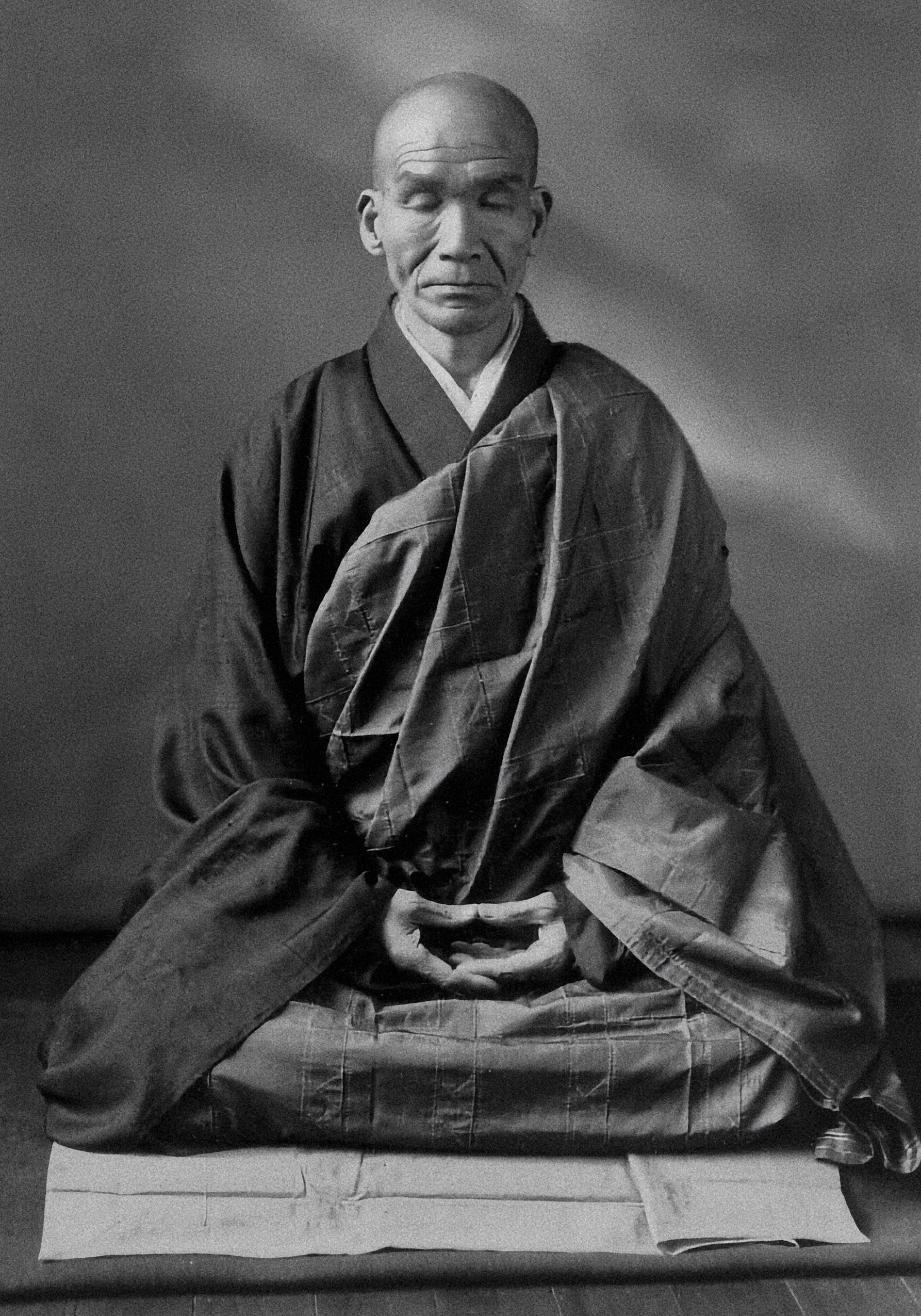
Kōdō Sawaki (1880 – 1965) democratised the practice of Zazen among lay people. “When one does zazen, the whole universe is doing zazen.”
It is the very mind itself
That leads the mind astray;
Of the mind,
Do not be mindless.
A Wonderfully Useless Art
As a means of achieving long-lasting mental equanimity, Zazen (坐禅) is unparalleled. This is not a case of importing Eastern concepts and shoehorning them into our magic, but instead an example of how a very specific state of mind can be achieved and utilised throughout the rest of the sorcerer’s life for great benefit independent of one’s magical practice. This Task has no number and is only the first half of a specific lesson in the manner in which we must master some aspect of our Self in order to master the art of Sorcery. Why bring this up in a Guide about the Grimorium Verum? Well, I will explain the reasoning in this essay and its second half titled, ‘Invoke Often!’
As of the time of writing I have been a student of Zen for 17 years and have applied my experiences in this useless art to my sorcerous practice with great success. I highly recommend you attempt to apply some form of meditation practice to your daily routine, starting small, building up, then intensifying. In my opinion meditation is something we should all engage in, just as we should clean our teeth and wash our clothes.
It is a process that ends with Death.
Many people struggle to establish a meditation practice. You will hear people say that the reason is the ‘modern world’, as if people a century or a millennia ago didn’t have a whole host of problems and distractions to deal with. The truth is there has never been a good time to start meditating for common folk. We are however, bombarded by novel distractions in the current era which prey on our attention and make use of predatory gambling addiction tactics to harvest our engagement. Social media is one such nightmare. So, to escape this and build something of value, let us begin to practice restraint when it comes to our habits. Turn off the TV, put down the game pad, limit your presence on social media. Obviously, no one likes to hear this and everyone has an excuse. Understand that the voice of addiction is so insidious that it will convince you these are your own words and not those of some soulless tech-ghoul making billions from harvesting your anger through rage-bait. Take back control of your mind.
Secondly, meditation means we have to face boredom or trauma full on, and many people can’t be alone with their thoughts for a vast number of reasons. The way it was described to me by my senpai was, “Medicine is bitter”. Expect to be challenged, know you will heal. You will integrate and find new strength, even joy. I will add, I was taught early on in my practice that you are not meditating if you are meditating for a purpose. The goal of meditation is the same goal a bird has when it shits on your windscreen. It has no conception of what it has done. The anger you experience in your car as this happens as you sit in rush hour traffic.. that is the illusion, the structure we have self-inflicted, the curse we have collectively cast upon ourselves. In moments like that we should take a leaf from the book of the Chaos Magicians and Laugh as a means of experiencing Neither-Neither.
Once you’ve had your hungover head hit with a big stick by a somber priest on a Sunday morning as many times as I have, you’ll learn to laugh at the absurdity of it all.
Finally, and I can’t stress this enough, limit your dependances on recreational substances. No one is saying quit drinking or never enjoy a spliff, those things are wonderful when done outside of ingrained compulsion. They are not so wonderful when you are compelled to do them due to chemical imbalances you have established in the flesh of your brain. Meditation is a fantastic way to release yourself from addiction.
On the flip side, if you’ve never tried mushrooms, go get some, make a tea, and get your friends round for a sleep over. Bring instruments, playlists, board and card games and someone sober who is willing to cook food for you. Act like children. Find joy.
The Work of the Flesh
Both meditation and yoga, for the purpose of our Guide, are means to bring the Mind of the sorcerer into alignment with the Flesh. Ours is a practice of the World, not an escape to a higher realm. The body is not a limitation or a vessel of Sin, it is the primary vehicle and medium through which we encounter Spirit and experience Joy. Desire is the unceasing engine of Life. Sitting daily in silent meditation will teach you just as much about your body as it will your internal thinking processes. You will become familiar with its pains, with its needs and failings. This will teach you how to improve it so that you may live the life you desire.
Our goal should be a strong body and healthy mind.
As we begin, finding a comfortable place and time to sit in silence, we find our first experience of our internal dialogue to be an unceasing vortex of noise. A roiling chaos of emotion, memory and sensations. If we immediately attempt to tame it we will experience something equivalent to the feeling of taming a wild beast, attempting as best we can to prevent its violence from mauling us as we thrash around, both trapped within an inescapable cage. Instead we must first develop a deep compassion for ourselves and a complete willingness to let go of anything we may be holding on to. We step into a turbulent river and the only way in which we can pass over to the other side is to do the exact opposite of what we expect. Do not fight the current, it will only grow stronger. Instead, we must surrender our desire to succeed in crossing over, and we must continually surrender, over and over again, until we realise there is no distinction between us or the river and that there is no prize awaiting us on the shore of the other side. We flow into the river. We become the river. We become its flow. Until the rocks and the rapids pass, and we find ourselves within the Silence.
In theory this is exceptionally simple. In practice, it will take you a lifetime.
Set yourself the goal of sitting in a fixed and unmoving posture in total silence for ten minutes. This can be on a cushion on the floor or sitting upright on a chair without back support. Place your tongue on the roof of your palate immediately behind your teeth to prevent the build up of saliva, and place your right hand open palmed over your left. Touch the tips of your thumbs together and rest your hands above your crotch with your thumbs being equidistant from your belly button. Focus on the breath, on your inhalation and exhalation. Observe your mind and what occurs within it as you set yourself to this task. Allow the breath to rise and fall from your naval, filling your lungs slowly, holding for a moment, exhaling, then holding once more before repeating the process.
Eventually you will come to realise that you have been thinking about that time back in school when someone you thought was your friend told a lie about you and how that made you feel, or perhaps you sense a physical anxiety somewhere in your chest about an upcoming work meeting. It could be anything, from any aspect of your life, past, present or future. Equally, you may find that you have gone on a long sequence of thoughts and feelings all bound up in twisted complexities and have no idea for how long this may have been going on. You despair! I thought this was meant to be relaxing?! Why am I thinking about that raw sadness I experienced when my pet hamster died when I was 6? Why am I thinking about my credit card payments? What did that smile mean? Oh, shit!
I forgot to focus on my breath!
When you realise the focus on the breath has been lost, recentre and begin anew. Be compassionate to yourself. This is not a race, nor is it a competition. There is no difference between practicing Zen and showering to be clean, brushing our teeth or wiping our arse after a shit. This is not a esoteric practice designed to unleash your potential or improve your work-flow. I hope this practice makes you ungovernable.
The mind will conjure anything to avoid the Silence, but it is in the Silence where we reach a state of being of such infinite Joy that language simply fails to describe it. My experience is one of mining deep into the earth, I have to pass through layers of noise. I could also say it’s like diving into an abyssal ocean. I go deeper and deeper, through strata of furious sound and memory. Like a pressure valve, traumas which have been buried deep within will be released, sometimes volcanically. Allow yourself to express emotion as it arises in your flesh. Cry! Laugh! Explode into dance. Often days or weeks later, during the day while awake, or in your dreams, some revelation will strike you that has been buried deep within the strata of your brain-mind-soul like lightning.
MY GOD! THEY WERE FLIRTING WITH ME?!
Eventually, once these deep strata have been plumbed to some level and the largest or perhaps most obviously buried parts are released then you will reach a stage where such explosive realisations begin to pass. We begin to reach layers that have been entirely unconscious for most if not our whole lives. We will be challenged by what exists in these strata, and we must come to terms with our behavioural conditionings. They will not be pretty. This is where I have found keeping a journal to be the most important of practices. If you can record and speak out these findings, you can gain some power over them. Self-knowledge is power.
This entire process is but the preamble to Meditation. We are, in a way, integrating ourselves and, dare I say it, becoming Conscious. The problems that are buried deep may have bound you or may be manipulating your actions, but once you become conscious of them you gain the ability to recognise their influence on you and then make a Conscious choice to behave differently. You begin to understand how to exist without being unconsciously compelled by external or unconscious forces.
Just continually bring yourself back to the breath. Breathe in. Breathe out. Don’t count. Don’t expect anything. Don’t do it to “gain enlightenment”. Just sit. Just breathe. That’s it.
Eventually we will be able to exist in a space where we can reach a state of meditation while walking to the shop for a carton of milk or while on the train commute to work in the morning. By engaging in this state we are passively exploring our own Self, equally, while we will still be bound and wound up by transitory stress factors, we can develop an ability to understand what activates them and then make a deliberate choice to approach them or react in a different manner. Even spending some time communicating these findings to your loved ones, your partner and your friends will help them navigate You better. This has been an exceptional, and still evolving part of my relationship with my wife and family. We can’t always cure these issues, and real issues need help from professionals, but by being aware there IS an issue is life changing.
We can tap into this state of equanimity during moments of high stress, take our inhalation, centre and choose to act without being subject to our conditioning. This comes in extremely handy while in the often stressful environment of the Circle during conjuration as well as offering the boon of a clear mind, free from worries and concerns which may distract us during our rituals. What’s more, such Consciousness can help us understand our motivations and can ultimately lead us to making better, more informed decisions.
The experience of developing a consistent meditation practice is one which will be of such an amazing benefit that once you have begun it, you will never want to stop. No matter who you are or what walk of life you come from, the benefits can not be overstated. If you are ever blessed to reach a state of Silence, you will understand its value can’t be communicated, it must be experienced.
This Concludes the first half of the Unnumbered Task of Aquarius
The Zen Masters of the Rinzai Tradition
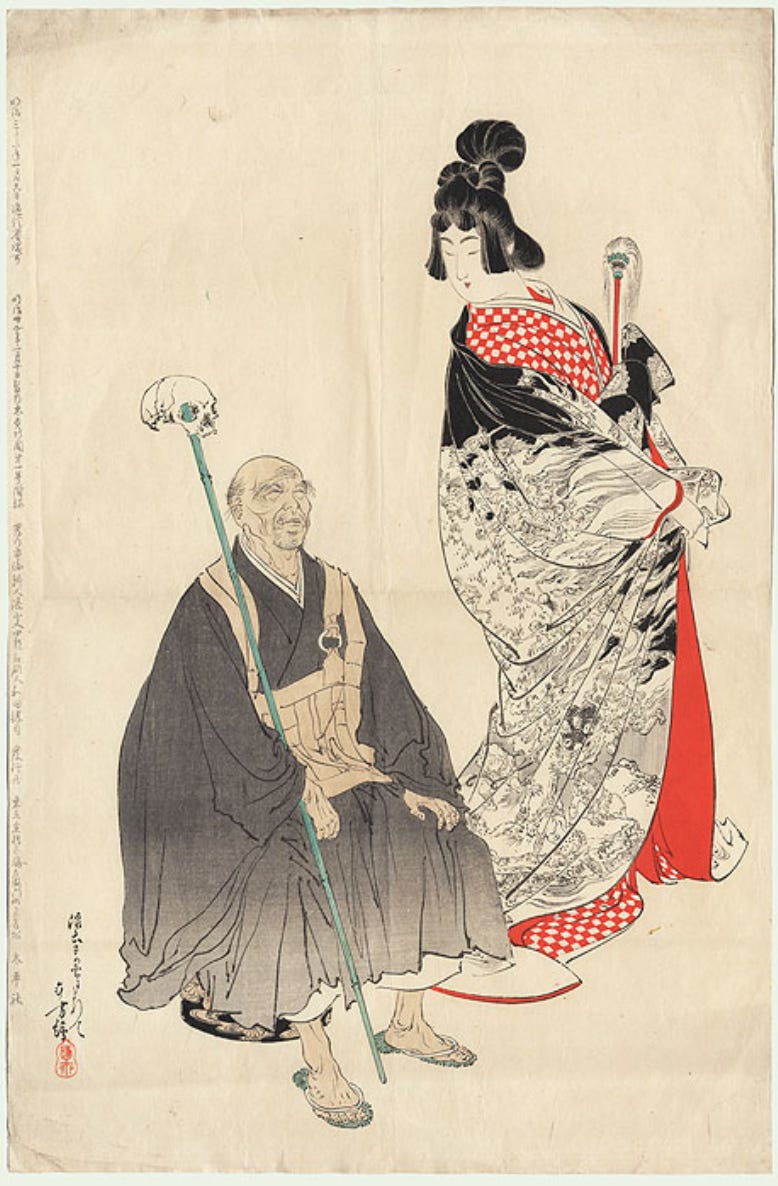
Takuan Sōhō (1573–1645) - General badass
Born in Izushi, Takuan Sōhō was a disciple of Shun’oku Sōen and a confidant to Tokugawa Iemitsu (1604–51). He served the Rinzai school of Zen Buddhism as the head priest of Daitoku-ji in Kyoto, starting in 1607, was exiled to Ideba in today’s Yamagata Prefecture in 1629, and became the founder of Tōkai-ji in 1638.
A certified Zen master, Takuan gained popular acclaim as the teacher of the legendary samurai Miyamoto Musashi (1584–1645). His intellectual accomplishment lies in the theory of self-cultivation, as developed in his treatise The Mysterious Records of the Mind of Unmovable Wisdom. In this sword-fighting manual, he applies basic ideas from the Platform Sūtra (Dangyō), most prominently, the juxtaposition of the “abiding mind” (Jūshin) and the “no mind” (Mushin) to sketch the process of psycho-physical transformation that he believed any practitioner of meditation or martial arts undergoes.
Discussing the ideal mindset of a practitioner of sword fighting (Kenjutsu), Takuan lays out his basic metaphysics, ethics, and religious ideology. The text commences by distinguishing between two states of mind: the “delusional mind” (Mōshin) that “abides in a place” (Jūchi) and the “no-mind” that flows freely through the body of the practitioner as well as the body of the opponent. The no-mind, Takuan explains, flows like water and is illustrated by the thousand arms of Kannon Bodhisattva. Kannon can move her arms simultaneously, since she is not attached to any individual one of them.
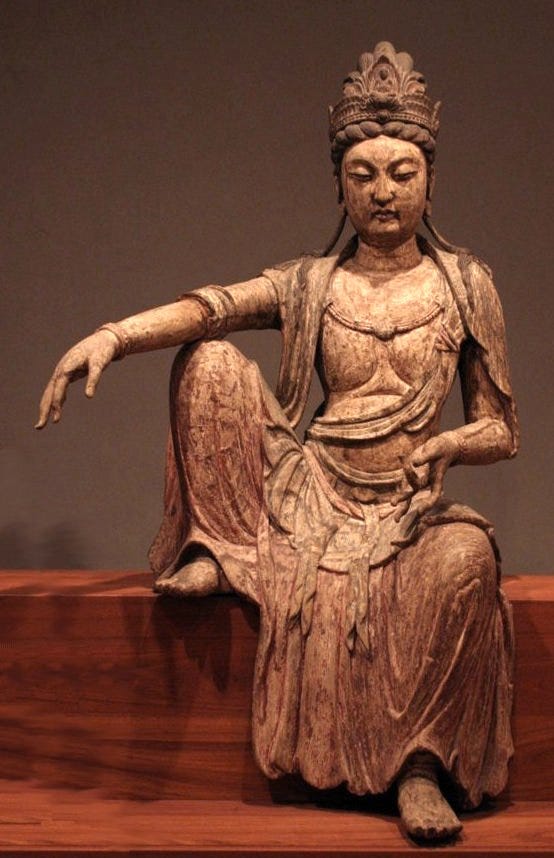
Kannon, known as Guanyin in China. “The One Who Perceives the Sounds of the World”. Northern Song dynasty, c. 1025. By making petition to her on the mountainside of Ozu, my wife and I were able to conceive our first child. She has become the patron Goddess of our household.
The practice of both Zen meditation and sword fighting is designed to transform the delusion of the everyday mind that is attached to thoughts, emotions, and the objects of the senses, into “no-mind.” “No-mind” is the state, Takuan continues, where “all buddhas” (Shobutsu) and “sentient beings” (Shūjō) are “one” (Funi). Such an attitude of detachment is not only beneficial to combat but constitutes the attainment of buddhahood. Interestingly enough, Takuan adds the suggestion that such a mind also realizes that the three teachings, Buddhism, Shintō, and Confucianism, are originally one. He thus applies the Chinese notion of the “three teachings” (Sangyō) to the Japanese context.
https://www.buddhistdoor.net/features/the-zen-masters-of-the-rinzai-tradition/
https://www.buddhistdoor.net/features/the-metaphorical-sword/